Labour contractions in 8 questions.
Labour contractions in 8 questions
- What is a contraction during labour?
- How do you tell real contractions from "false labour"?
- What are the first symptoms of a labour contraction?
- How often do labour contractions come, and how long do they last?
- How do you ease or manage contractions naturally?
- When should labour be induced, or when should you see a professional?
- How do you prepare mentally and physically for labour contractions?
What is a contraction during labour?
Labour contractions are the tightening and releasing of the muscles of the uterus.
They're the "engine" that opens the cervix and moves your baby toward being born. They're often described as a wave or a tightening that starts low in the belly, can spread to the back, and comes more and more often as the birth approaches 🤰.
When you work with families in Quebec, I'm often asked whether this is "the moment" or just a false alarm.
Don't worry: this is one of the most universal questions there is, and everyone feels contractions in their own way — but there are a few clues that help you recognize them!

Did you know?
The Ysé Naissance doulas can round out your pregnancy care; they offer a complete support to get ready and be fully informed of the steps and paperwork to plan for.
How do you tell real contractions from "false labour"?
One of the most common worries is mistaking the start of real labour for "false labour" (Braxton Hicks contractions). Braxton Hicks are irregular, usually painless, and don't get stronger over time. Real contractions, by contrast:
| Feature | False labour (Braxton Hicks) | Real labour |
|---|---|---|
| Rhythm | Irregular, variable | Regular, getting closer together |
| Intensity | Mild and steady | Builds gradually |
| Where you feel it | Often at the front | Front + lower back |
| Response to rest or changing position | Fade away | Keep going or get stronger |
Tip: if you change position, have a bath or drink some water and the contraction goes away, it's probably Braxton Hicks. If not, get ready: the real thing may be starting !
What are the first symptoms of a labour contraction?
Here are the telltale signs:
A tightening or heavy feeling low in the belly, which can radiate into the back
Pain that builds gradually and comes back at regular intervals ⏳
A hardening of the uterus, sometimes visible or noticeable to the touch: the belly forms a "ball"
Losing clear fluid or fluid tinged with blood (known as "losing the mucus plug", or your waters breaking)
An urge to open your bowels, or a feeling of pressure in the pelvis
Every woman experiences this moment differently: some describe it as a very strong period cramp, others feel the tension in their lower back.

Looking for support from a certified doula?
Book your first discovery call.
How often do labour contractions come, and how long do they last?
One topic that always comes up in childbirth preparation: timing your contractions! The ones that mean real labour are:
⏰ Regular: at first they come every 15 to 20 minutes, then gradually get closer together (every 5 to 3 minutes in the active phase)
🧘🏻♀️ Length: from 30 seconds at the start up to 60–90 seconds as the birth approaches
🌊 Intensity: builds over time, along with a feeling of impatience or of losing control (which is completely normal!)
A small tip: keep track of how often they come using an app or good old pen and paper. It helps you tell whether it's time to head to the hospital or to call on your doula for support.
How do you ease or manage contractions naturally?
Many families want to know how to get through this stage as calmly as possible, sometimes with fewer medical interventions. Here are several methods backed by midwives and doulas.
- Mindful breathing: learning to focus on the out-breath lengthens the relaxation and lowers how much pain you feel.
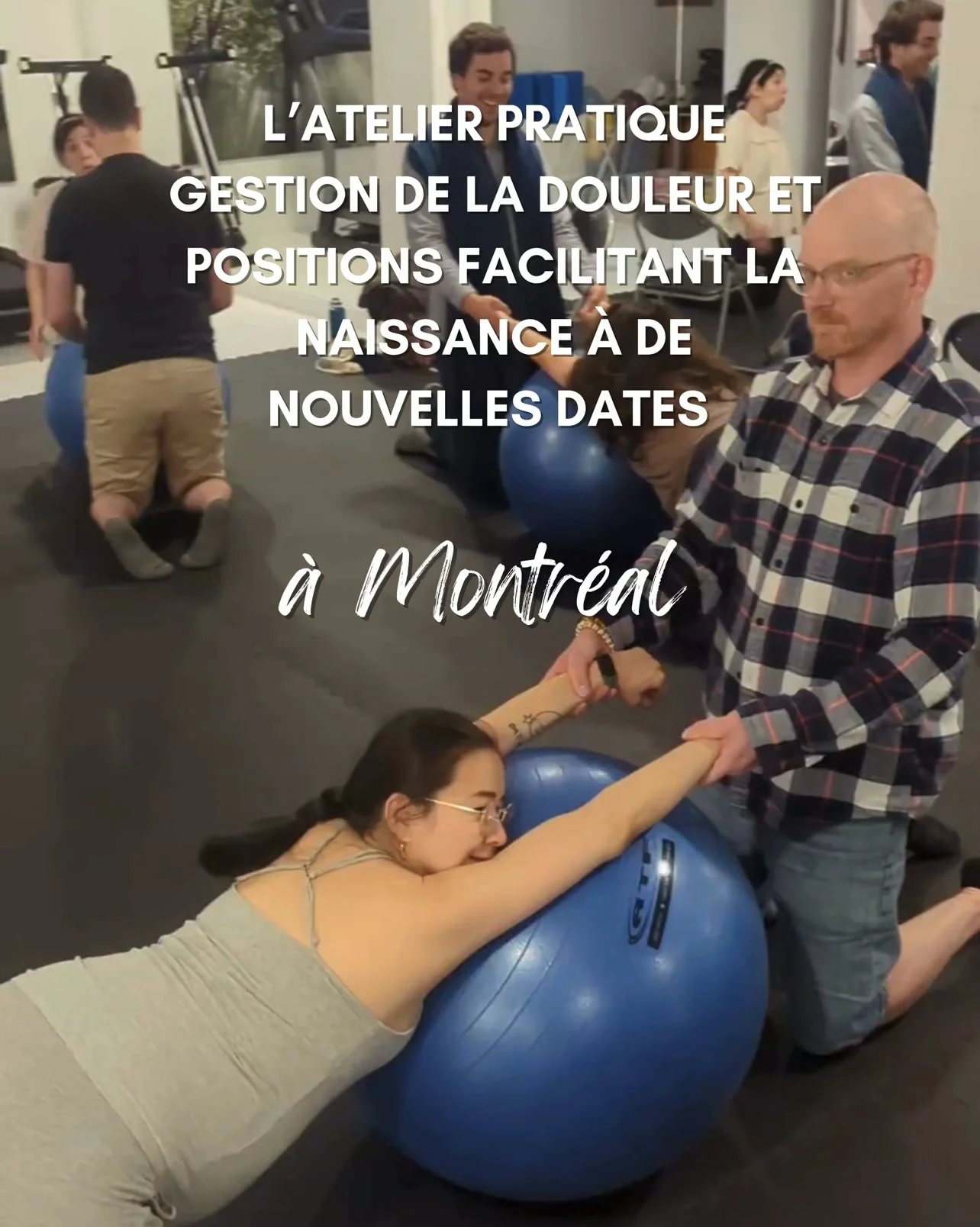
- Movement: walking, rocking on a birthing ball, changing position regularly… 🌿
- Warm baths (or showers): warm water encourages the muscles to let go and brings immediate relief.
- Massage: physical contact, especially on the lower back, helps channel the pain and reinforces the feeling of being supported.
- Visualization: images, gentle words and positive anchors, which we often share during emotional preparation for the birth.
- Heat (a hot water bottle or heat pad on the lower back).

Meet our team
Different personalities, one dedicated team, so you get support that fits who you are.
When should labour be induced, or when should you see a professional?
Some situations mean you shouldn't wait:
⏰ Regular contractions every 5 minutes or less, for more than an hour (for a first baby)
💧 Loss of amniotic fluid (a clear break or a slow leak)
🩸Bright red bleeding
👶🏻 Reduced movement from your baby
🏥 Unbearable pain that doesn't let up
👉 If you're giving birth at a birth centre or in hospital, contact your medical team without delay (midwives, obstetrician or doula).
Have a look at the directory of maternity emergency numbers to find the contacts closest to you.
How do you prepare mentally and physically for labour contractions?
The best preparation? Give yourself as many resources as you can, both in knowledge and emotionally 🧘♀️. A few starting points:
💪🏻 Take part in a childbirth preparation (in person or online)
🧘🏻♀️ Work on relaxation: prenatal yoga, mindfulness meditation, sophrology…
✍🏻 Write a birth plan your choices, your wishes, your limits — something we can put down on paper together.
🫂 Surround yourself: your partner, a doula or birth companion, your chosen family
💭 Picture how it will go: remind yourself that every contraction brings you closer to your baby ❤️
My most valuable piece of advice: trust your body. We often forget how thoroughly it's built for this event, and there's a whole community of support around you, here in Quebec, ready to help.

Remember that every pregnancy is unique
Choosing a birth doula can make all the difference to how you experience becoming a parent.
Find all of the childbirth preparation services on offer as well as the reviews families supported by the Ysé Naissance team ⭐️⭐️⭐️⭐️⭐️