5 birth positions to ease the pain.
- What's the best position to give birth in?
- Why is lying on your back the most common position?
- What are the alternatives to lying down?
- Can you change position during labour?
- Birthing positions with your partner
- The birthing ball: a comfortable alternative
- The 5 stages of labour and why positions matter
Birth is a one-of-a-kind moment in a woman's life, and choosing the right birthing position can make a real difference to the mother's comfort, the length of labour and the baby's well-being.
For centuries, lying flat on the back has been the favoured position in hospitals, but more and more women are looking for more natural, physiological alternatives. From squatting to lying on your side to using a ball, mothers-to-be in Quebec have plenty of choices.
This article will walk you through the different positions birthing, their pros and cons, their effect on pain, and help you choose the one that best fits your needs and your situation.
Every position for a gentler birth
An illustrated guide from our doulas: the positions that help baby descend, ease pain naturally and support every phase of labour. Free to download.
What's the best position to give birth in?
There's no no single ideal position for pushing, but some suit the needs of mother and baby better than others.
What to take into account:
✔️ With an epidural : some positions are off the table, but lying on your side is often recommended to free up the sacrum and help the baby out. A walking epidural, meanwhile, allows a much wider range of positions (on your side, on all fours, and so on).
✔️ Without an epidural : upright positions (standing, squatting, on all fours) use gravity and make for a more natural birth. Generally, in a birth without an epidural, your body makes it easy to feel the ideal position to push in.
✔️ Pain management : some positions make contractions easier to cope with and reduce pain naturally.
✔️ Your partner's role : if you'd like the dad to support you physically, some positions — squatting while leaning on him, for instance — are ideal.
It's a good idea totry several positions beforehand to see which ones feel most natural and comfortable to you.
Why is lying on your back the most common position?
Despite its drawbacks, this position is still the norm in many hospitals:
📌 Medical access : this position makes it easier for doctors and nursing staff to monitor labour and step in if needed.
📌 Hospital convention : since the 17th century, this position has been popularized by modern obstetric practice.
This position does, however, sometimes slows labour and makes pushing harder, which is why it's worth considering other options.

Master these positions before the big day
Our certified doulas come to your home and guide you and your partner through the positions best suited to your body, your pelvis and your birth plan. Fully personalized content, covered by private insurance.
Can you change position during labour?
Yes, and that's often recommended !
📌 Less pain : changing position can relieve the pressure and ease painful contractions.
📌 Helping the baby descend : some positions help the baby settle better into the pelvis.
📌 Avoiding stalls : alternating between positions keeps labour from stalling.
Midwives and birth companions generally encourage women to try several positions as labour goes on.
Birthing positions with your partner
Birth is an intense moment, physically and emotionally, and having an attentive co-parent there can make all the difference. Whether it's the second parent, a relative or someone you trust, their support helps the mother-to-be manage the pain, feel safe and go through the experience in the best possible conditions.
Birth takes a lot of effort, and some positions need outside support to hold for any length of time. This is where the co-parent plays an essential role:
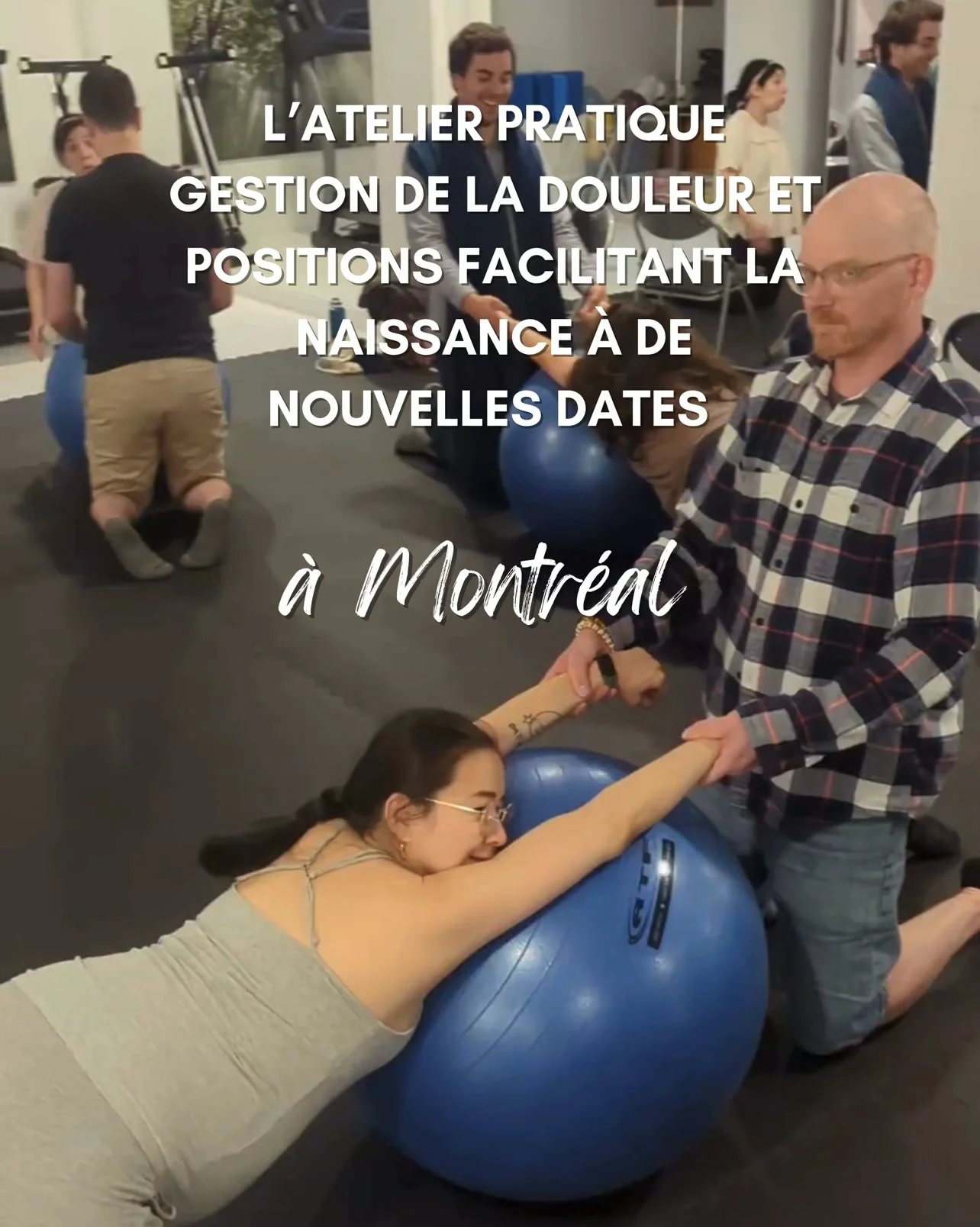
✔️ Squatting while leaning on your co-parent : this posture uses gravity to help the baby out and open the pelvis. It can be tiring, though, which is why the co-parent can stand behind the mother and support her under the arms, helping her hold the position while taking some of her weight. He can also sit behind her and give her something solid to lean against.
✔️ Helping you change position : during labour, it's a good idea to alternate positions to avoid stalling and to reduce pain. Your co-parent can help you get up, lean on them, or shift position gently.
The prenatal classes group classes are a great way to practise with your co-parent!


The birthing ball: a comfortable alternative
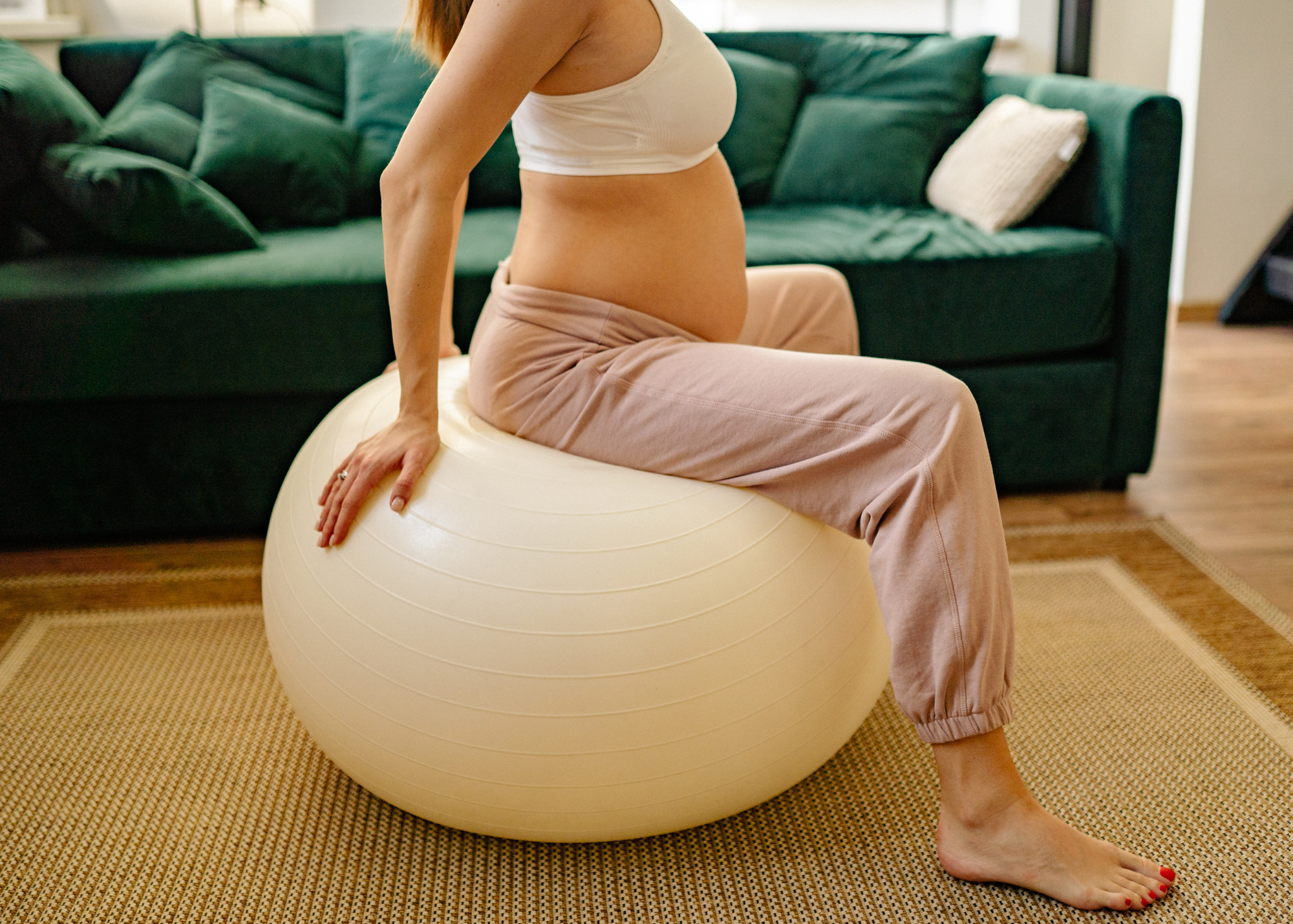
The birthing ball, also called a birth ball or Swiss ball, is a favourite among pregnant women for easing tension and helping labour along. Comfortable, versatile and simple to use, it's an effective alternative to the classic positions because it lets the mother-to-be keep moving while taking the edge off the contractions.
It's especially recommended from the earliest stages of labour, once the cervix starts to dilate and the contractions become more regular. Using it lets you helps labour progress more smoothly while helping the pregnant woman manage her stress and her pain.
| Benefits of the birthing ball | Explanations |
|---|---|
| 💐 Easing pain naturally | The movements you make on the ball — gentle rocking or circling of the pelvis — reduce the pressure on your back and perineum. They also help relax the muscles and release endorphins, the body's natural feel-good hormones, which dull the sensation of pain. |
| 🧘🏽♀️ Helping the pelvis open | Sitting on the ball keeps the mother-to-be's pelvis mobile, which helps the baby descend. Unlike lying down, which can slow labour, using the ball encourages the pelvis to open as fully as possible and lets the baby settle better into the birth canal. |
| ↻ Improving blood flow and getting oxygen to the baby | Moving on the ball stimulates blood flow, which improves the baby's oxygen supply and helps prevent things like numbness or leg pain. |
| 🤸♀️ Staying mobile while being supported | Unlike standing positions, which can be tiring, the ball lets you stay mobile without carrying your whole body weight. The mother-to-be can lean on the ball to make soft, flowing movements that help her cope with contractions. |
| 🥼 A useful tool with or without an epidural | Even with an epidural, using the ball can help — sitting or semi-reclined in particular — to encourage labour to progress smoothly while keeping discomfort down. |
| 🤰🏻 Making the transition between the phases of labour easier | The ball makes it easy to change positions, which is essential for avoiding stalls and adapting to the intensity of the contractions. |
The 5 stages of labour and why positions matter
| Stage of labour | What happens in the body | Which position should you go for? |
|---|---|---|
| 1️⃣ Early labour | The cervix begins to soften and gradually dilate. Contractions are irregular and not very painful. | 🔹 Walking slowly to help the baby descend 🔹 Sitting on the ball to relax the pelvis 🔹 Gentle stretching to release tension |
| 2️⃣ Active labour | The contractions become regular, stronger and more frequent. The cervix gradually opens to 7 cm. | 🔹 On all fours to ease lower back pain 🔹 Squatting to speed up dilation 🔹 On the ball to cope better with contractions |
| 3️⃣ Transition | The most intense phase, when the cervix reaches 10 cm. Contractions are very close together and very strong. | 🔹 On your side to avoid too much pressure on the perineum 🔹 Squatting, leaning on your co-parent 🔹 Leaning over a ball or a bed to release tension |
| 4️⃣ Pushing and birth | The baby moves down and out through the birth canal as you push. This is the moment of birth. | 🔹 Squatting to open the pelvis as wide as possible 🔹 Semi-seated to make use of gravity 🔹 On all fours to manage pushing better |
| 5️⃣ Delivery of the placenta | The placenta is delivered after the baby is born. Contractions continue but are less intense. | 🔹 Lying on your back or side to help deliver the placenta and recover 🔹 Skin-to-skin contact with baby to encourage oxytocin |

You're getting ready for the birth — let's think about afterwards too
Once baby arrives, our doulas come to your home: they watch your newborn, make a hot meal and look after your recovery. A real hand so your first weeks don't leave you exhausted.

Remember that every pregnancy is unique
Choosing a birth doula can make all the difference to how you experience becoming a parent.
Find all of the childbirth preparation services I offer as well as the reviews families I have supported. ⭐️⭐️⭐️⭐️⭐️